
The $100 Billion Circle
In 2000, Pets.com became the poster child for dot-com excess. The company spent millions on a Super Bowl ad featuring a sock puppet mascot, completed a $300 million IPO, and nine months later, it was bankrupt. Everyone remembers the puppet. Fewer remember what happened to the infrastructure behind it.
While Pets.com was flaming out, telecommunications giants WorldCom and Global Crossing were spending over $500 billion laying fiber optic cable, enough to circle the Earth 1,500 times. When the bubble burst, most of that cable sat dark and unused. The technology was sound. The internet was real. But the infrastructure buildout had raced miles ahead of actual demand.
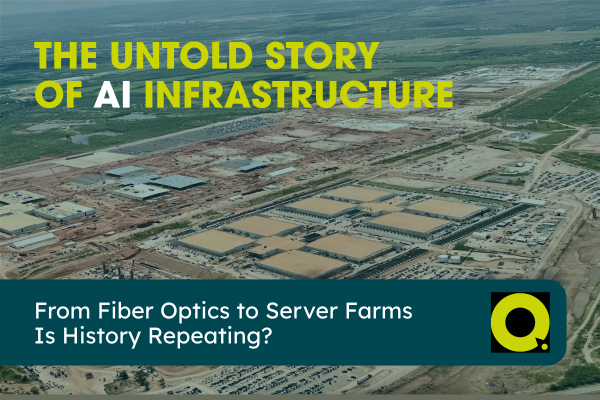
Today, we're watching a similar pattern unfold—but this time with AI data centers instead of fiber optics.
Early October, Nvidia announced a $100 billion investment in OpenAI. Days later, OpenAI committed $300 billion to Oracle for computing power over five years—$60 billion annually. Meanwhile, OpenAI projects just $13 billion in revenue for 2025 while burning billions. The circle is complete: chip makers invest in AI companies that use that investment to buy more chips.
This isn't the AI bubble everyone fears. It's something more specific and more familiar: an infrastructure bubble wrapped in circular financing.
The Iron Man Principle: What AI Actually Does
Before dismissing the entire AI sector, let's establish something crucial: AI works. The question is what it does—and that has profound implications for infrastructure requirements.
Augmentation, Not Replacement
In survey after survey, the pattern is consistent: 87% of executives believe employees are more likely to be augmented than replaced by generative AI. This isn't corporate spin designed to calm nervous workers; it's showing up in hard productivity data.
The pattern reveals something fundamental about how AI creates value. It doesn't replace expertise; it distributes it. It's not Iron Man's suit replacing Tony Stark; it's amplifying what he can do while bringing others closer to his level.
The Efficiency Revolution
In January 2025, a Chinese AI company called DeepSeek released results that sent shockwaves through every infrastructure investment thesis on Wall Street.
The Training Cost Breakthrough
DeepSeek demonstrated that AI models could be trained at roughly 1/30th the typical cost using techniques like Mixture-of-Experts architecture and sparse attention mechanisms. More importantly for ongoing economics, their models ran inference—the actual use of AI—at 20 to 50 times cheaper than comparable models from OpenAI.
This matters because:
- Local model explosion: Llama 3, Mistral, Qwen, and dozens of others can run entirely on-premises.
- The SME Reality Check: When buying your own hardware beats cloud economics at just 10 users, the "infinite scalability" narrative starts to break down.
Edge Computing—The SME Leapfrog
While hyperscalers commit hundreds of billions to centralised infrastructure, a quieter revolution is happening at the edge. The Edge AI market reached $20.87 billion in 2024 and is projected to grow significantly through 2030.
SMEs in Cardiff or Cleveland can now deploy AI where they need it—on-device, at the factory floor, in local servers—rather than shuttling sensitive data to distant data centers and paying for the privilege.
The Coming Correction
The infrastructure bubble will deflate. The question isn't if, but how gracefully—and what survives.
The correction won't kill AI any more than the dot-com crash killed the internet. Pets.com failed, but Amazon survived and thrived. The correction will rationalise infrastructure investment, just as 2001 eventually gave us the cloud computing that powers today's economy.
What This Means for Different Players
- For SMEs: Wait for the efficiency curve to bend further. Use cloud services for convenience, but deploy AI where it adds value locally.
- For Developers: The opportunity lies in the efficiency layer. The companies that figure out how to deliver AI capabilities at 10% of current costs will capture enormous value.
Clues from the past
In 2000, we confused excitement about the internet with validation of every internet company. In 2025, we're at risk of confusing the value of AI with the necessity of current infrastructure spending.
Recognising the difference matters for your investment portfolio, your business strategy, and your technology roadmap.