
Research on tens of thousands of stories and essays finds that AI makes each piece of work better but the whole collection more alike. Whether that holds depends on how people are involved.
Imagine a room full of writers, each given the same assignment. Some will invent an unlikely villain. Others will dispense with the villain altogether. One might write a comedy, another a tragedy, and a third something so peculiar that nobody is quite sure what to call it.
Now replace most of those writers with artificial intelligence.
The stories may be fluent, convincing and occasionally brilliant. But something curious happens when researchers compare them. The machines, despite their apparent inventiveness, often return to familiar territory. Their stories begin to resemble one another.
It is a problem hiding inside one of AI's greatest achievements. We have built systems that can help almost anyone produce competent creative work. Yet the more people rely on the same kind of assistance, the more we risk losing the differences that make their work worth reading.
And the evidence goes further than everyone sounding a little like ChatGPT.
The shape of a story
In 2026, Jenna Russell and colleagues published StoryScope, a study of 61,608 stories written from 10,272 prompts. Each prompt was answered by a human author and by five large language models, with every story running to about 5,000 words.
The researchers did not count repeated phrases or look for familiar vocabulary. They extracted 304 narrative features from each story, looking at how stories were built: who makes the choices, how time moves, how plots escalate.
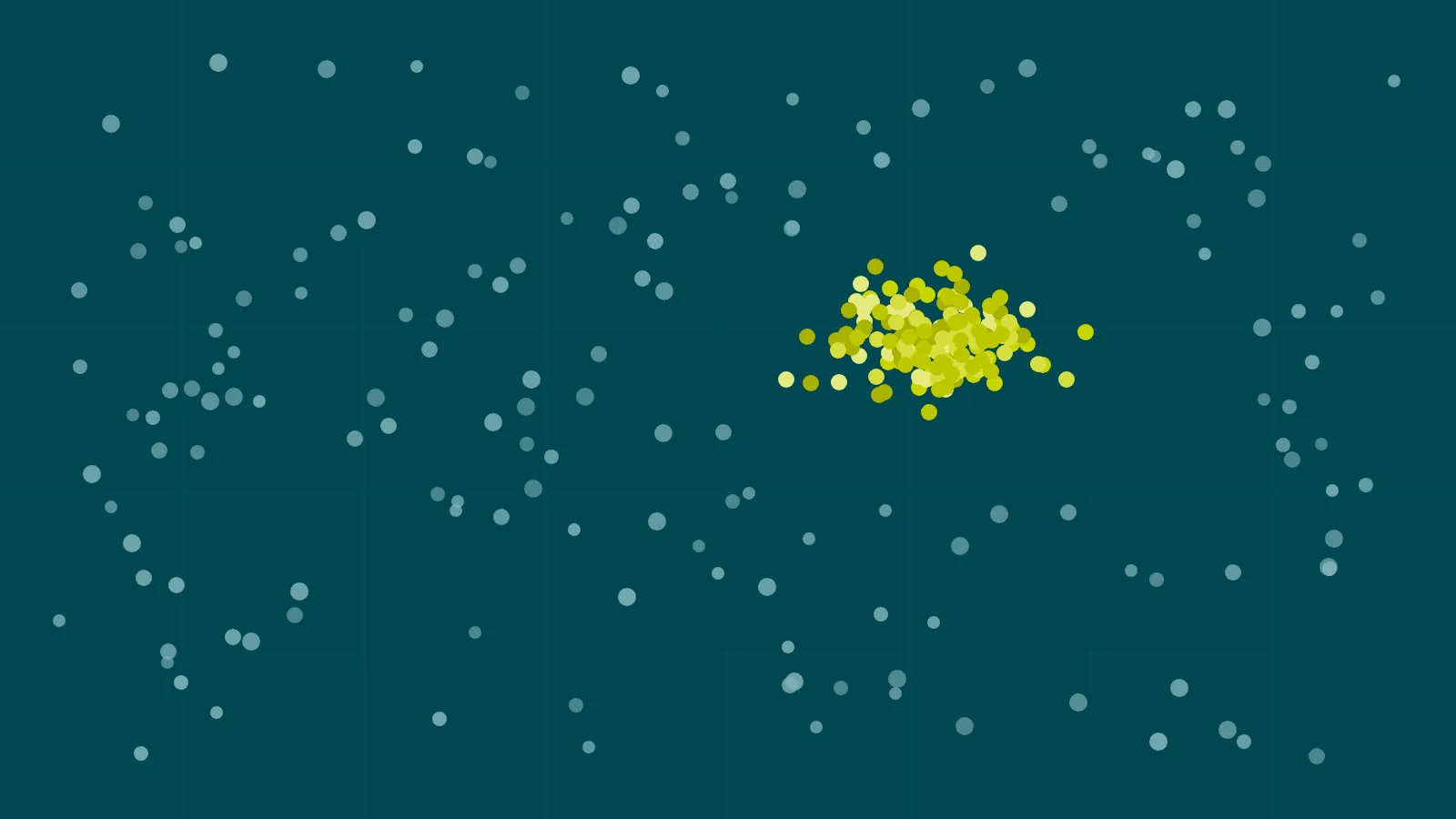
Human stories spread across a wider range of narrative possibilities. AI-generated stories clustered in a shared region. The AI stories tended to over-explain their themes and favour tidy, single-track plots. The human ones framed their characters' choices as more morally ambiguous and played more freely with time.
Each model had its own habits. Claude's plots escalated notably little; GPT leaned on dream sequences; Gemini described characters from the outside. Yet all five landed in the same neighbourhood.
Think of a map on which every possible narrative has its own location. Human writers wander across more of it. The AI systems, for all their speed and fluency, keep visiting a smaller patch.
That does not make their stories bad. Some may be excellent. The problem becomes visible when we stop judging each story separately and look at the collection.
One good story is an achievement. Ten thousand good stories built around increasingly similar choices are a different cultural proposition.
Better stories, fewer surprises
Two years earlier, Anil Doshi of UCL and Oliver Hauser of the University of Exeter had found a related paradox.
Their 2024 study in Science Advances asked people to write short stories. Some worked alone. Others were offered story ideas generated by an AI model.
Access to AI ideas led to stories that were rated more creative, better written and more enjoyable. The gains were largest for writers who were less creative to begin with.
On an individual level, this looked like a success. AI was helping people produce work they might otherwise have struggled to create.
But the researchers also compared the stories with one another, and those written with AI ideas were more similar.
For participants offered one AI-generated idea, the increase in similarity was equivalent to 10.7 per cent of the range of similarity scores seen among writers working without AI. That is a carefully defined experimental result, not a general measure of how much AI reduces originality. The authors describe the pattern as a social dilemma: each writer is better off, but the group produces a narrower range of new work.
It is rather like giving every chef access to the same exceptionally capable adviser. The meals improve. Fewer are disappointing. But if the adviser keeps recommending similar ingredients, the menu gradually becomes less adventurous.
The risk here is uniform excellence.
The missing ideas
The same concern appears beyond fiction.
A 2025 study by Moon and colleagues, published in Computers in Human Behavior: Artificial Humans, examined 2,200 college admissions essays across three preregistered studies, comparing human writing with essays produced by GPT-4.
The question was not whether the AI could write a convincing application. It was how much new material each additional essay added to the collection.
Each additional human essay contributed more new ideas than each additional GPT-4 essay.
This matters because originality is not only a property of a single piece of writing. It also belongs to the wider pool of ideas from which a society, an industry or an organisation draws.
A thousand polished answers are not necessarily as useful as a thousand genuinely different ones.
In 2026, Wenger and Kenett reported a related result in PNAS Nexus. They gave three divergent-thinking tasks to 102 people and 22 language models. The models did well on individual answers, but their responses varied far less across the population than the humans' did.
Being creative on demand is not the same as sustaining creative diversity at scale.
But the machines are not condemned to repeat themselves
There is an important complication. Not every experiment finds that AI reduces diversity.
Joshua Ashkinaze and colleagues ran an experiment with more than 800 participants in over 40 countries. People who were shown many AI-generated example ideas before brainstorming did not produce more creative ideas individually, but the ideas of the group became more diverse.
Separately, Wan and Kalman found that giving an AI deliberately varied personas preserved the diversity of stories written with its help.
These are not trivial objections. They challenge the simplest version of the argument.
If AI always pushed people towards the same ideas, changing the way it was used should make little difference. In some experiments, it does.
The conditions matter. Seeing a range of AI-generated examples is not the same as letting a model co-write your work. Asking a system for its most likely answer is not the same as deliberately asking for conflicting perspectives or unusual approaches.
The technology can offer alternatives. Whether they appear, and whether anyone pursues them, depends on the process around it.
That shifts the question. Perhaps the problem is not that AI cannot be original. Perhaps it is that the easiest way to use AI does not reliably produce originality.
The value of the unexpected
People do not approach a problem as blank slates. They bring personal histories, inconvenient experiences, local knowledge, prejudices, ambitions and contradictions.
Two people can hear the same story and remember entirely different details. They can look at the same problem and disagree about what the problem actually is.
Those differences are not always efficient. They are frequently frustrating. They can also be the beginning of something new.
AI is exceptionally good at recognising patterns in what has already been written, discussed and made. That is a large part of what makes it useful. It is also one reason a system built to produce plausible responses may return to well-travelled paths.
That raises a practical question for anyone using AI to write, design, plan or solve problems. Are we asking it to help us think, or letting it decide what is worth thinking about?
There is a difference between using AI to test an unusual idea and asking it to supply the idea in the first place. Between asking for criticism and asking for reassurance. Between exploring possibilities and accepting the first polished answer.
This matches what we see at WeGetDesign, though it is our experience rather than a measured result.
"When we have tried to fully automate the development of a product, with no human input, we tend to get the standard version of it. The more people are involved in the planning and the workshops, the more the product gets pulled in different directions and the more depth it gains. In our experience, that is what makes a product distinct." Omar Moulani, Director, WeGetDesign
Those choices are made by people.
What this research does and does not show
These studies measure particular tasks: short fiction, long-form stories, admissions essays, brainstorming and divergent-thinking tests. They use particular models at particular moments, and models change quickly. None of them tests business, design or software work directly.
They do not show that humans are inherently more creative than machines, or that AI-assisted work must become homogeneous. Some of the research points the other way when the tools are used differently. The view that human judgement is what keeps work varied is our reading of the evidence, not something these studies measured.
The future may depend on who asks the better question
The most interesting implication of this research is not that AI makes creativity worse. In some circumstances, it clearly makes individual work better.
The concern is subtler. As capable systems reach more people, producing something competent becomes easier, and competence itself becomes less distinctive.
What remains difficult is knowing when the competent answer is the wrong one. Spotting an overlooked possibility. Bringing an experience the model has not been given. Choosing a direction that is less obvious but more appropriate.
Originality cannot be judged only by the quality of one finished result. We also have to ask what happens when everyone uses the same tools to reach it.
Perhaps the most consequential question in the age of generative AI is not whether a machine can write a good story.
It is whether, with a machine helping everyone, we will still have enough different stories to tell.
Sources
- Russell, J., Rajendhran, R., Pham, C. M., Iyyer, M. and Wieting, J. (2026). StoryScope: Investigating idiosyncrasies in AI fiction. COLM 2026. arxiv.org/abs/2604.03136
- Doshi, A. R. and Hauser, O. P. (2024). Generative AI enhances individual creativity but reduces the collective diversity of novel content. Science Advances 10(28), eadn5290. doi.org/10.1126/sciadv.adn5290
- Moon et al. (2025). Homogenizing effect of large language models (LLMs) on creative diversity: an empirical comparison of human and ChatGPT writing. Computers in Human Behavior: Artificial Humans. sciencedirect.com
- Wenger and Kenett (2026). Large language models are homogeneously creative. PNAS Nexus 5(3). doi.org/10.1093/pnasnexus/pgag042
- Ashkinaze, J., Mendelsohn, J., Li, Q., Budak, C. and Gilbert, E. (2025). How AI ideas affect the creativity, diversity, and evolution of human ideas. Collective Intelligence 2025. arxiv.org/abs/2401.13481
- Wan and Kalman (2026). Diverse AI personas can mitigate the homogenization effect. Computers in Human Behavior: Artificial Humans. arxiv.org/abs/2504.13868
Research last checked: 19 October 2026. By WeGetDesign.